
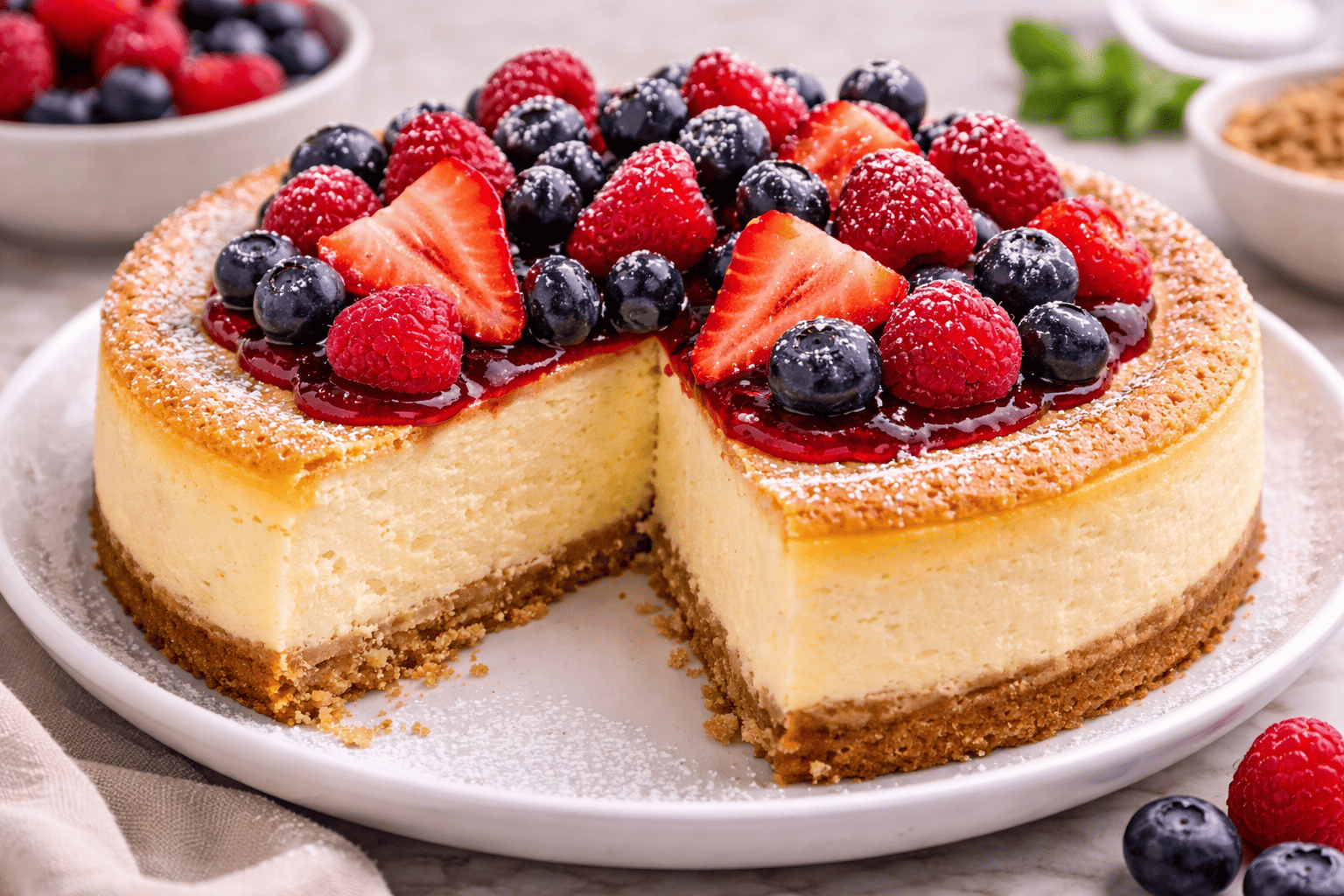
There are desserts that achieve greatness through drama — meringue, for instance, performs its magic through whipped air and heat, transforming egg whites into something architectural and ethereal. Ricotta cheesecake takes the opposite approach entirely. It achieves greatness through quietness: a gentle, barely-sweet filling, a tender crumb, and a restrained richness that leaves you reaching for another slice without quite understanding why. It is one of the most elegant things Italian baking has produced, and it is considerably easier to make than its reputation might suggest.
Ricotta Cheesecake vs. the American Version
The distinction matters, and it is worth making clearly. The American-style cheesecake most people picture — dense, towering, cream-cheese-based, and intensely rich — is a magnificent thing, but it is a fundamentally different dessert from its Italian counterpart. Where the American version is bold and assertive, Italian cheesecake is subtle and nuanced. The ricotta filling is lighter in texture, less sweet, and carries a faint graininess that gives it character. It tastes of dairy in the purest sense: clean, fresh, and gently tangy.
This difference in character makes ricotta dessert of this kind particularly versatile. It is at home at a dinner party, a holiday table, or a quiet Sunday lunch with no occasion attached to it at all.
The Cheese: Where It All Begins
A good ricotta cheesecake recipe starts with good ricotta, and the quality of your cheese will determine the quality of your result more than any other single factor. Fresh whole-milk ricotta, ideally from an Italian deli or made at home, produces a filling that is creamy, delicate, and subtly sweet. The tub ricotta commonly found in supermarkets works but tends to be wetter and less flavorful; if using it, drain it overnight in a cheesecloth-lined strainer to remove excess moisture before proceeding.
The filling itself is straightforward: ricotta, eggs, sugar, a small amount of flour or cornstarch to stabilize, and flavorings. Lemon zest is the classic addition, brightening the filling and cutting through the richness of the cheese. Vanilla extract, a splash of orange blossom water, or a tablespoon of good rum all work beautifully as alternatives or additions.
The Crust Question
Italian cheesecake takes several approaches to its base. The most traditional version uses a pastry crust — a short, buttery pasta frolla pressed into the pan and blind-baked before the filling goes in. This gives the finished cake a proper pastry quality and holds up well when sliced. A simpler approach uses crushed amaretti cookies or digestive biscuits mixed with melted butter, pressed into the base and chilled. Both work; the pastry version is more classical, the biscuit version is faster.
Some versions of baked ricotta cheesecake dispense with the crust entirely, baking the filling directly in a buttered and floured pan. The result is rustic and honest, with a lightly golden exterior and a soft, yielding center.
Baking Low and Slow
The most important technical consideration in making a baked ricotta cheesecake is temperature. A moderate oven — around 325°F — allows the egg proteins to set gently without curdling, producing a smooth, crack-free surface and a filling that is just barely set in the center when it comes out of the oven. Residual heat finishes the job as the cake cools.
A water bath is not strictly necessary for ricotta cheesecake in the way it is for cream cheese versions, since the lower fat content makes the filling less prone to cracking. That said, placing the pan in a shallow tray of hot water during baking adds insurance and produces an especially silky result.
The Vegan Version
A vegan ricotta cheesecake is well within reach using cashew-based or almond-based ricotta, which can be made at home by blending soaked nuts with lemon juice, a small amount of apple cider vinegar, and salt until smooth. Combined with coconut cream and a starch-based binder, it produces a filling that is genuinely impressive — rich, tangy, and convincing enough to satisfy anyone at the table regardless of dietary preference.
A Cake That Earns Its Quiet
Italian cheesecake does not announce itself. It simply delivers, slice after slice, with the kind of consistent, unfussy excellence that only the simplest and most well-considered recipes ever manage to achieve.