
There is a moment, common to anyone who has eaten great desserts across different culinary traditions, when something stops you completely — not because it is complicated or showy, but because it is so precisely itself. Ricotta cheesecake achieves that with its quiet, creamy restraint. Knafeh achieves it with heat, cheese, syrup, and crunch, producing a combination so immediate and satisfying that first encounters with it tend to be remembered in some detail. It is one of the great desserts of the Arab world, and it is long overdue for the wider recognition it deserves.
What Is Knafeh?
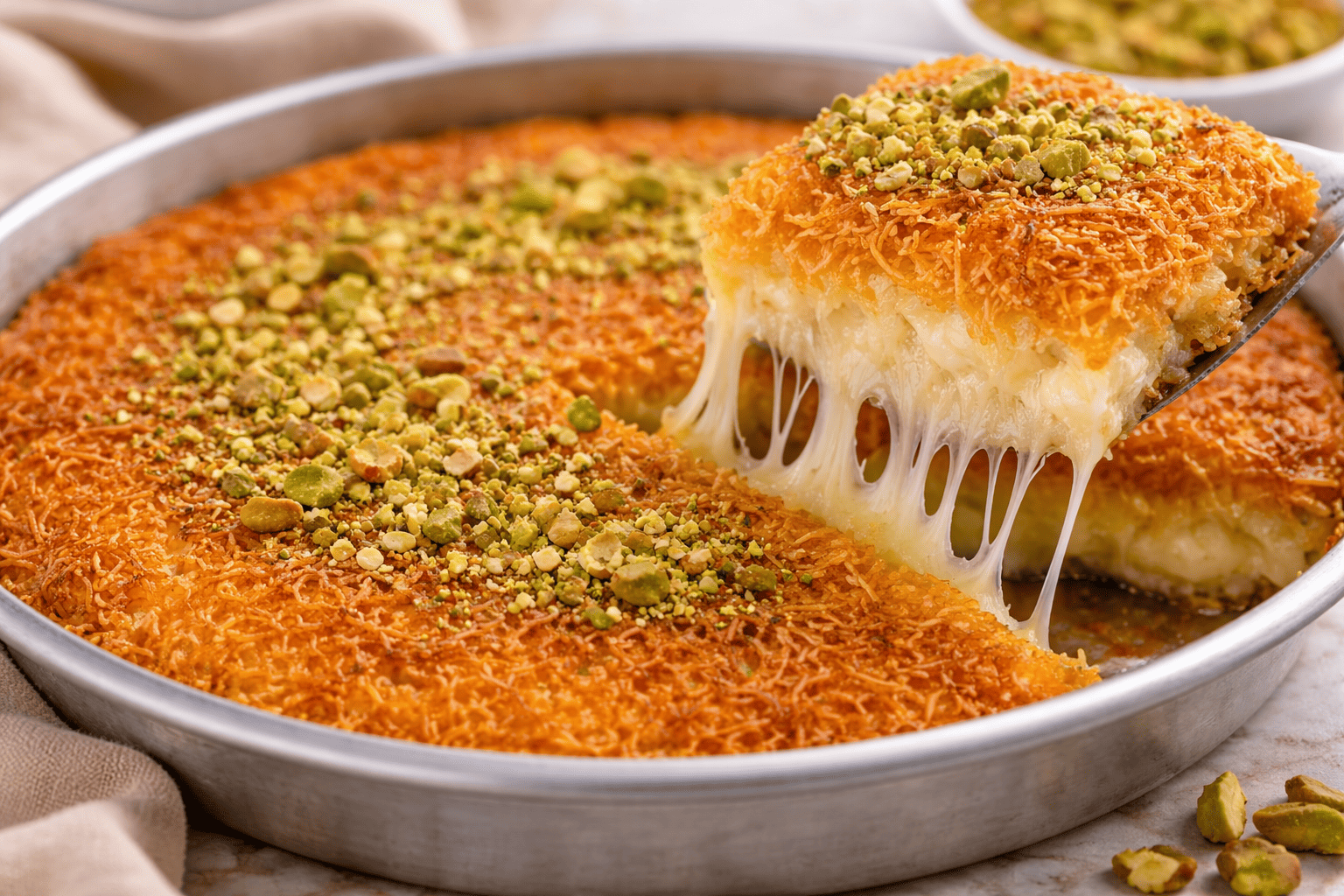
Knafeh is a baked cheese pastry soaked in sugar syrup, built in layers and served hot. At its most fundamental, it consists of a cheese filling — mild, stretchy, and lightly salty — sandwiched between layers of either shredded wheat-like pastry strands or a fine semolina dough, all of it soaked after baking in a fragrant sugar syrup flavored with rose water or orange blossom water. The top is typically colored a deep orange-red with food coloring, garnished with crushed pistachios, and served immediately while the cheese is still molten and the pastry still crisp.
The interplay of textures and temperatures is what makes it so compelling: the crunch of the pastry against the pull of the melted cheese, the sweetness of the syrup against the saltiness of the filling, the heat of the pan against the cool air of wherever you happen to be eating it.
The Question of Origin
Few dishes in the Middle East inspire as much passionate regional pride as knafeh, and the debate over its true origin is conducted with considerable feeling. The city of Nablus, in the northern West Bank, has the strongest claim, and knafeh nabulseyeh — the Nablus style, made with a specific local white brine cheese called Nabulsi — is widely regarded as the gold standard of the form. Nablus has built an entire civic identity around the dish, with dedicated knafeh shops that have operated for generations and queues that form before the morning batch is out of the oven.
The Turkish tradition also has a long history with the pastry; knafeh turkish versions tend to use slightly different cheese and dough preparations, sometimes incorporating clotted cream alongside the cheese filling for additional richness. Across Lebanon, Syria, Jordan, and the Palestinian territories, every region has its own variation, its own preferred cheese, its own ratio of syrup to pastry, and its own firm conviction that its version is the correct one.
Understanding the Dough
The two main formats of knafeh dough are what distinguish most regional variations. The first uses kataifi — fine, vermicelli-like shreds of pastry that are pressed into a pan, filled, topped with more shreds, and baked until golden and crisp. The result has a fibrous, nest-like texture that soaks up the syrup while retaining some crunch. The second version uses a fine semolina-based knafeh dough pressed into a smooth, dense layer that bakes into something closer to a soft cake than a shredded pastry. This version, sometimes called the “soft” style, has a more uniform texture and a slightly more delicate crumb.
Both are legitimate. Both are excellent. Preference tends to come down to what you grew up eating.
Pistachio and Cheese: The Essential Garnish
However it is made, pistachio knafeh is the finished form most commonly encountered — finely ground raw pistachios scattered over the syrup-soaked surface just before serving, providing color, flavor, and a final layer of texture. The green of the pistachios against the orange-red pastry is one of the more visually striking presentations in all of Middle Eastern baking, and it tastes as good as it looks.
Making Knafeh at Home
Knafeh pastry is increasingly available in the frozen sections of Middle Eastern and international grocery stores, making home preparation far more accessible than it once was. The most important rule is to use the right cheese — Nabulsi if you can find it, or a combination of fresh mozzarella and ricotta or akkawi as a widely available substitute. The syrup should be made fresh, flavored generously with rose water, and poured over the hot pastry the moment it comes out of the oven.
Serve it immediately. Knafeh waits for no one.