
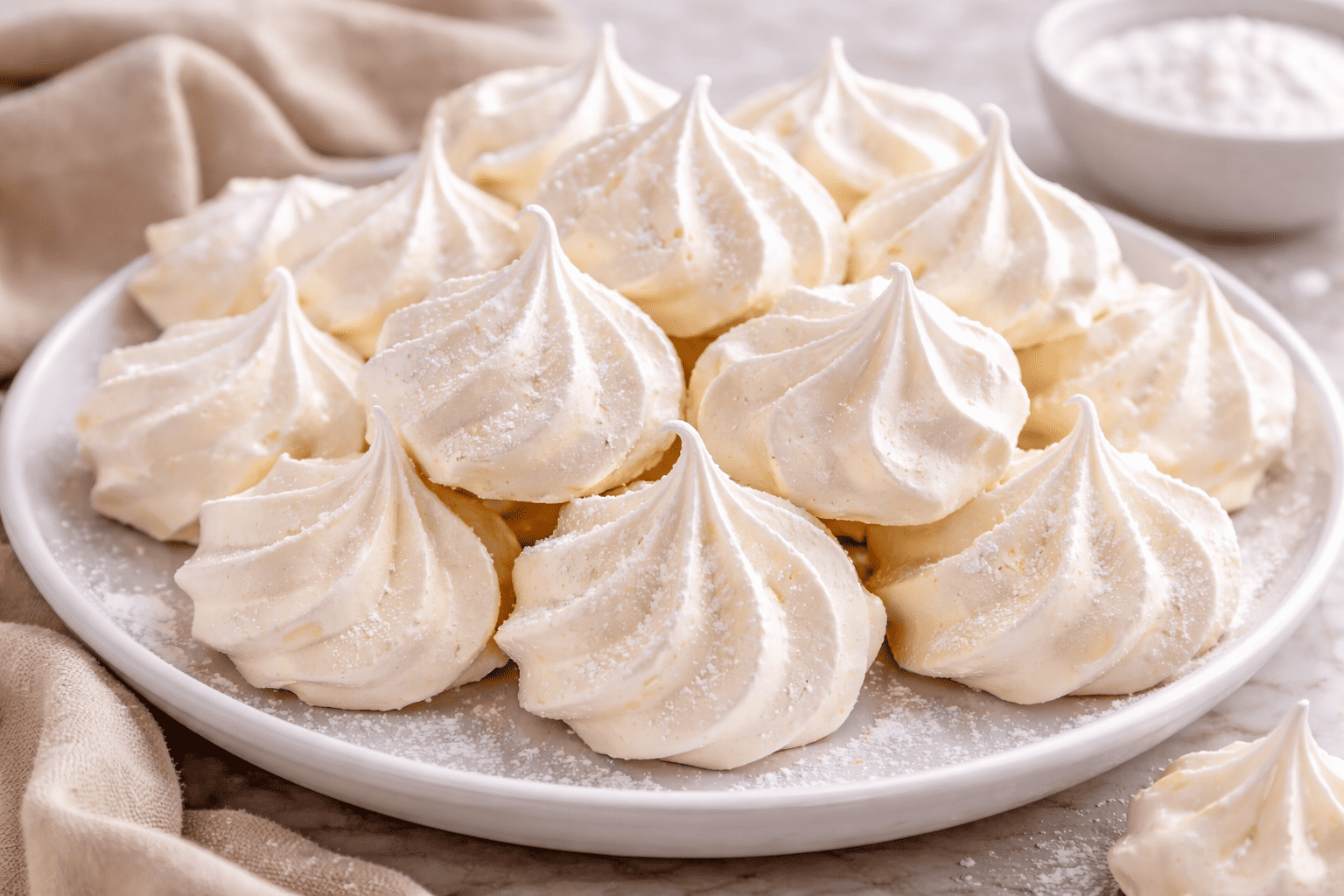
There are ingredients in baking that transform so completely during preparation that the finished product bears almost no resemblance to what you started with. Kataifi pastry begins as a simple dough and emerges from the oven as something crackling and golden and entirely new. Meringue does something equally remarkable with far fewer ingredients: egg whites and sugar, whipped together and subjected to heat, become a substance that is simultaneously crisp and marshmallowy, delicate and structural, simple and endlessly adaptable. It is one of the foundational achievements of the pastry kitchen, and understanding it opens up an enormous range of techniques and desserts.
What Meringue Actually Is
At its core, meringue is a foam — air bubbles trapped within a network of protein and sugar. When egg whites are beaten, the proteins in the whites unfold and link together around air bubbles, creating a stable foam. Sugar, added during whipping, strengthens this network and draws in moisture, producing a glossy, dense, and stable result. The ratio of sugar to egg white and the method of incorporating the sugar determine which type of meringue you end up with, and the differences between types are significant.
The Three Types Worth Knowing
French meringue is the simplest: raw egg whites beaten with caster sugar until stiff and glossy, then baked low and slow until completely dry. It is the most straightforward method and the most fragile, best used for baked meringue shells, pavlovas, and crisp cookies. It is also the least stable of the three types and should be used and baked promptly.
Meringue swiss style — or Swiss meringue — involves heating the egg whites and sugar together over a double boiler until the sugar is fully dissolved and the mixture reaches around 160°F, then whipping to stiff peaks. The gentle cooking makes it safer to consume when used in applications where it won’t be fully baked, and it produces a particularly smooth, satiny result. Butter swiss meringue buttercream, made by beating softened butter into cooled Swiss meringue, is one of the great cake frostings: silky, less sweet than American buttercream, and stable enough to pipe beautifully.
Italian meringue is the most technically demanding and the most stable of the three. Hot sugar syrup — cooked to the soft ball stage at around 240°F — is poured in a thin, steady stream into whipping egg whites, cooking them as it incorporates. The result is a dense, glossy, marshmallow-like meringue that holds its shape indefinitely, is safe to eat without further baking, and is used extensively in professional pastry for finishing tarts, topping pies, and making mousses and buttercreams.
Lemon Meringue Pie: The Classic Application
No discussion of meringue is complete without addressing lemon meringue pie, which is perhaps the most iconic meringue application in the American baking tradition. A sharp, intensely flavored lemon curd filling sits in a blind-baked pastry shell, topped with billowing peaks of meringue that are browned under a broiler or with a kitchen torch until golden. The contrast between the tart curd and the sweet, yielding meringue is one of the great flavor combinations in all of dessert making. French or Italian meringue both work for this application; Italian meringue produces a more stable result that is less prone to weeping.
Meringue Powder and Royal Icing
For bakers who work with decorated cookies and celebration cakes, meringue powder royal icing is an invaluable tool. Meringue powder — made from dried egg whites, sugar, and stabilizers — can be whisked with water and powdered sugar to produce a royal icing that dries to a hard, smooth finish without the food safety concerns of raw fresh egg whites. It pipes cleanly, sets firmly, and keeps well, making it the professional standard for decorated sugar cookies and elaborate cake designs.
A Few Rules That Always Apply
Whatever type you are making, meringue demands clean equipment. Any trace of fat — including egg yolk — in the bowl or on the whisk will prevent the whites from whipping properly. Use a metal or glass bowl rather than plastic, which can harbor invisible grease. Age your egg whites slightly if possible; whites that are a few days old whip more easily than very fresh ones. And add your sugar gradually — rushing this step produces a grainy, unstable result.
Respect these rules, and meringue will reward you with something close to magic every time.