
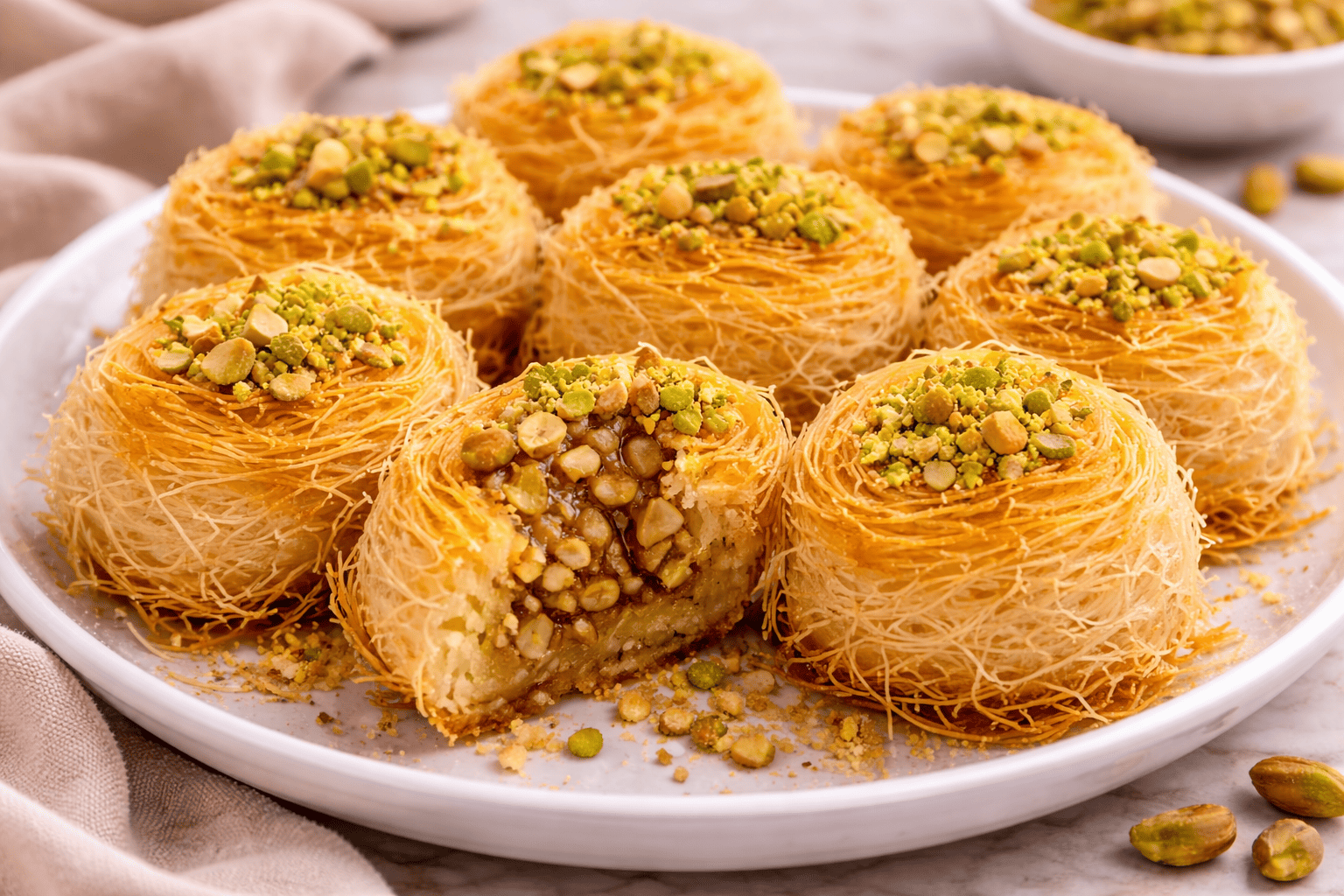
There are ingredients in the world of baking that function almost as a cheat code — something you add to a recipe that immediately elevates the entire result with very little additional effort. Flan achieves its magic through the alchemy of caramel and custard, two simple components that together produce something far more elegant than either manages alone. Kataifi works differently, contributing texture above all else: a crackling, golden, thread-like crunch that transforms whatever it surrounds or supports into something extraordinary. It is one of the most versatile and underused ingredients available to the home baker, and once you start cooking with it, it is very difficult to stop.
What Is Kataifi?
Kataifi pastry is a form of shredded phyllo dough — the same thin, unleavened pastry used in baklava and börek, but extruded into fine, hair-like strands rather than rolled into sheets. Raw kataifi looks like a nest of pale, soft vermicelli; baked, it becomes a tangle of crisp, golden threads with a delicate crunch and a faintly nutty flavor that intensifies as it browns. It absorbs butter readily, caramelizes beautifully, and pairs with sweet and savory flavors equally well.
The name comes from the Arabic and Turkish culinary traditions in which the pastry has been used for centuries, and it remains a cornerstone ingredient across Middle Eastern, Greek, and broader Mediterranean baking. The word itself refers both to the pastry and to the specific desserts made from it, which can cause some confusion in recipes — context usually makes the intended meaning clear.
Working with Kataifi Dough
Fresh or thawed kataifi dough needs to be handled with some care. Straight from the packaging, it is compressed into a tight roll and must be gently teased apart before use — pulling small amounts away from the mass and loosening the strands with your fingers until they are airy and separated. Working too aggressively breaks the strands into short fragments that don’t weave together properly during baking; working too gently leaves clumps that bake unevenly.
The most important rule is to keep it covered with a damp cloth while you work. Kataifi dries out quickly, and dry strands become brittle and difficult to shape before they even reach the oven. Keep what you’re not immediately using protected, and work in small batches.
Butter is the essential fat for most kataifi applications — melted and brushed or drizzled generously through the strands before baking. Some recipes use clarified butter or a neutral oil for a lighter result, but the flavor of good unsalted butter combined with the toasted pastry is difficult to improve upon.
The Classic Dessert Applications
The most traditional use of kataifi pastry is in the dessert of the same name: a filling of chopped nuts — typically walnuts, pistachios, or a combination — wrapped in a bundle of buttered pastry strands, baked until deeply golden, and soaked in a fragrant sugar syrup flavored with lemon, cinnamon, and rose water or orange blossom water. The syrup-soaked result is sticky, sweet, and deeply satisfying, with the crunch of the pastry playing against the soft, sweet nut filling inside.
Shredded phyllo dough also forms the outer layer of knafeh, where it is pressed into a pan, filled with cheese, topped with more pastry, baked, and finished with syrup and crushed pistachios. In this application the pastry functions as both structure and texture, giving the dish its characteristic crunch before the syrup softens the exterior just enough.
Savory Uses Worth Exploring
Shredded fillo dough is equally at home in savory applications. Wrapped around prawns before frying, it produces a spectacular crisp coating that shatters on contact. Pressed into tart cases and blind-baked, it creates shells with far more texture and character than standard shortcrust. Layered with cheese and herbs and baked in a pan, it becomes a savory pie that is every bit as compelling as its sweet counterparts.
Finding Kataifi
Kataifi pastry woolies — a term used particularly in Australian and New Zealand markets, where the pastry is sold under this name — can be found in the freezer sections of Middle Eastern grocery stores, Mediterranean delis, and increasingly in mainstream supermarkets. It keeps well frozen and thaws quickly at room temperature.
Handle it gently, butter it generously, and bake it until properly golden. Kataifi rewards patience and punishes rushing.