
There are desserts that intimidate by reputation alone — your soufflé, with its legendary tendency to collapse the moment you glance at it sideways, your croquembouche, your hand-laminated croissant. And then there is the éclair: elegant, refined, and possessed of a mystique that far outstrips how approachable it actually is to make at home. Once you understand the basics, éclairs become one of the most rewarding bakes in your repertoire.
What Makes an Éclair an Éclair?
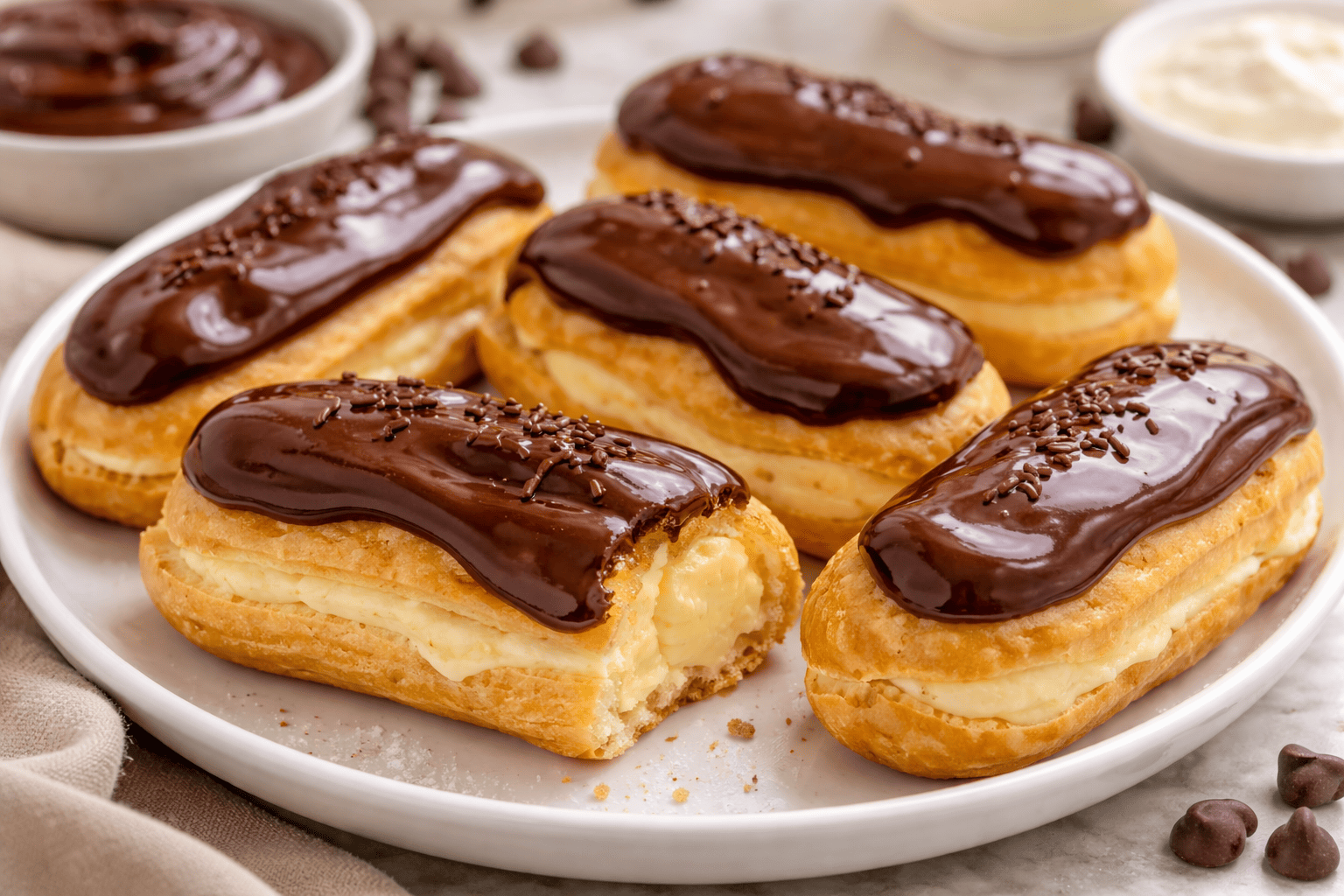
An éclair is a finger-shaped pastry made from choux dough — the same light, hollow dough used for cream puffs and profiteroles. Baked until golden and crisp, then filled with a rich cream and finished with a glossy glaze on top, it is a study in contrast: delicate shell, lush interior, smooth topping. A chocolate eclair, the most iconic version, is finished with a shining dark chocolate ganache that sets into a coating you can tap with your fingernail.
The word “éclair” is French for “lightning,” and while food historians debate whether the name refers to the speed with which they disappear or the way the glaze catches the light, both explanations feel right.
Starting with Choux Pastry
Choux dough is genuinely unlike any other pastry dough. It begins on the stovetop: butter and water are brought to a boil, flour is stirred in all at once, and the mixture is cooked until it pulls away from the sides of the pan into a smooth ball. Eggs are then beaten in one at a time until the dough is glossy and just barely drops from a spoon in a slow, reluctant ribbon.
The key to good choux is steam. There is no leavening agent — the water in the dough turns to steam in the oven and puffs the pastry from the inside out, creating that characteristic hollow interior. This means your oven door stays shut during baking. Opening it too early releases the steam and causes the shells to collapse, which is the one genuine pitfall of the process.
Pipe the dough in straight lines — about four inches long for a standard éclair, or shorter if you’re making mini eclairs for a party spread. Bake at a high temperature to set the structure, then reduce the heat to dry out the interior. The finished shells should feel light and hollow when you tap them.
Éclair Filling: Where the Magic Lives
The traditional eclair filling is pastry cream — a thick, velvety custard made from egg yolks, sugar, milk, and cornstarch, cooked on the stovetop until it thickens to a spoonable consistency. Flavored with vanilla, it is quietly magnificent. Piped into a cooled shell through a small hole poked in the base, it fills every hollow corner and turns the fragile choux into something substantial and satisfying.
Pastry cream is also the perfect base for variations. Fold in whipped cream for a lighter diplomat cream. Add melted chocolate to the warm base for a mocha-tinged filling that pairs beautifully with the chocolate glaze. Or take things in an entirely different direction with a strawberry eclair: a filling made from strawberry pastry cream or fresh strawberry whipped cream, finished with a pale pink glaze and a slice of fresh fruit on top. It’s a summer éclair that converts even the most dedicated chocolate loyalists.
The Glaze and the Finish
A classic chocolate eclair is finished by dipping the top of the shell into warm ganache — a simple mixture of heavy cream and dark chocolate — and letting it set at room temperature. The ganache should be thick enough to coat without running, glossy enough to catch the light, and generous enough to reach every edge.
For fruit variations, a glaze made from icing sugar, a splash of lemon juice, and a small amount of food coloring works beautifully. It sets quickly and gives the pastry that polished, patisserie-window finish.
Why You Should Make Éclairs at Home
A well-made a chocolate eclair from a good bakery is a wonderful thing. But making éclairs at home — piping the choux, watching the shells puff in the oven, filling each one with cold, silky pastry cream — is a particular kind of satisfaction that no purchased pastry can replicate. The process teaches you something about dough, about heat, about patience.
Start with the classic. Then try mini eclairs for your next gathering. Then, when you’re ready, venture into strawberry territory. The éclair rewards curiosity.