
There is no single dessert that speaks for all of human sweetness. Every culture, every region, and every grandmother with a well-worn recipe card has contributed something distinct to the vast, delicious conversation that is the world’s dessert tradition. Some of the most rewarding experiences at a table come not from the familiar and expected, but from the dessert you have never tried before — the one that stops you mid-bite and makes you reconsider everything you thought you knew about what a sweet dish could be. From the American South to the streets of Bangkok, from Parisian patisseries to Middle Eastern bakeries, the world of dessert is wider and more generous than any single cuisine could contain.
The American Classics
Some desserts earn their place through sheer staying power. Chess pie, that deceptively simple Southern custard built from butter, sugar, and eggs, has been feeding families for centuries without once feeling the need to update itself or seek approval. It is the kind of dessert that reminds you why the simplest recipes are often the best ones. Pizookies — those gloriously underdone skillet cookies served hot with melting ice cream — represent a more recent American invention but have achieved the same kind of devoted following in a fraction of the time. And sticky toffee pudding, though it claims British heritage, has been adopted so enthusiastically across the Atlantic that it now feels equally at home on both sides of the ocean, its warm sponge and glossy caramel sauce converting everyone who encounters it.
The European Tradition
Europe has given the dessert world an embarrassment of riches. Éclairs — those finger-shaped choux pastries filled with silky cream and glazed with dark chocolate — are a masterclass in the French philosophy that technique and restraint produce the most lasting pleasure. Soufflé, despite its fearsome reputation for collapse and catastrophe, rewards the patient cook with something that no other dessert can replicate: a baked dish that rises on nothing but air and egg white into something almost impossibly light. And ricotta cheesecake, the quieter Italian answer to its more flamboyant American cousin, achieves its particular greatness through subtlety — a gentle, barely-sweet filling that leaves you reaching for a second slice before you have quite finished the first. Meringue, in its various French, Swiss, and Italian forms, underpins all three traditions and produces some of the most texturally extraordinary things in the entire pastry canon.
The Middle Eastern Pantry
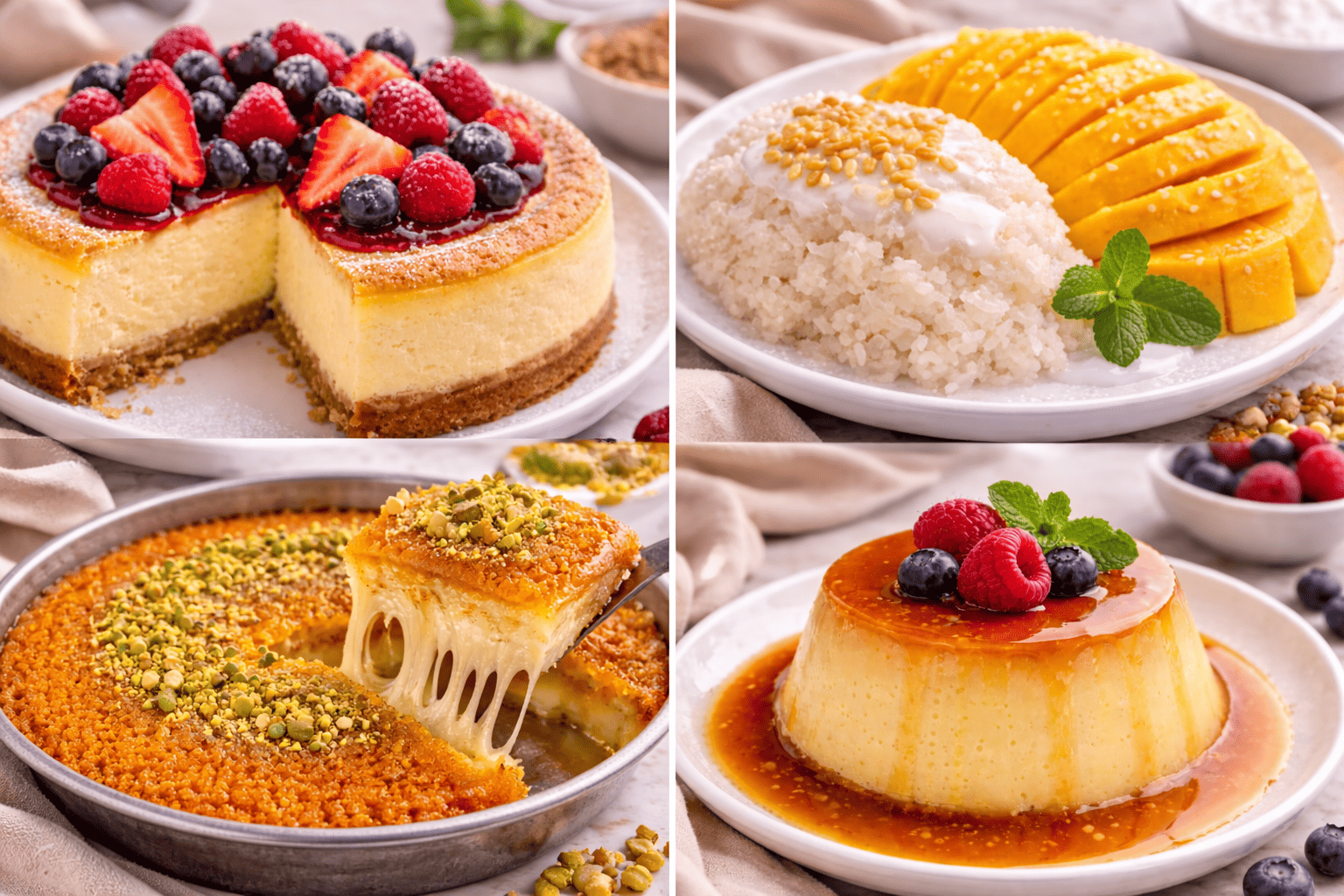
The Middle East has contributed desserts of such distinction that they deserve their own conversation. Knafeh — shredded pastry layered with molten cheese, soaked in rose water syrup, and finished with crushed pistachios — is one of the most immediately compelling things you can put in front of anyone at a table, regardless of their familiarity with the cuisine. Kataifi, the shredded phyllo dough that forms the basis of knafeh and countless other pastries, is a versatile ingredient that rewards any cook willing to work with it, producing crackling, golden textures that no other pastry can replicate. Together, these two represent a tradition of pastry-making that is as sophisticated and deeply considered as anything France or Italy has produced.
Across Asia and Latin America
Sticky rice with mango, the Thai dessert of glutinous rice cooked in sweetened coconut milk and served alongside ripe, fragrant fruit, is proof that restraint and quality of ingredients can produce something profound. Flan — that trembling, caramel-soaked custard that exists in one form or another across Latin America, the Philippines, France, and Spain — is one of the world’s most universally beloved desserts, a dish that different cultures have independently arrived at and made their own. And ambrosia dessert, that creamy, fruit-laden American classic, carries with it the warmth of generations of shared tables.
Why Dessert Matters
Sopapilla, pulled hot from the oil and drizzled with honey, is not trying to be sophisticated. It is trying to make whoever is eating it happy, and it succeeds completely. That is true of every dessert on this list, and of every great dessert ever made: beneath the technique, the tradition, and the cultural history, the purpose is always the same. Dessert is how we celebrate, how we comfort, and how we tell the people at our table that the meal is not quite over yet.