
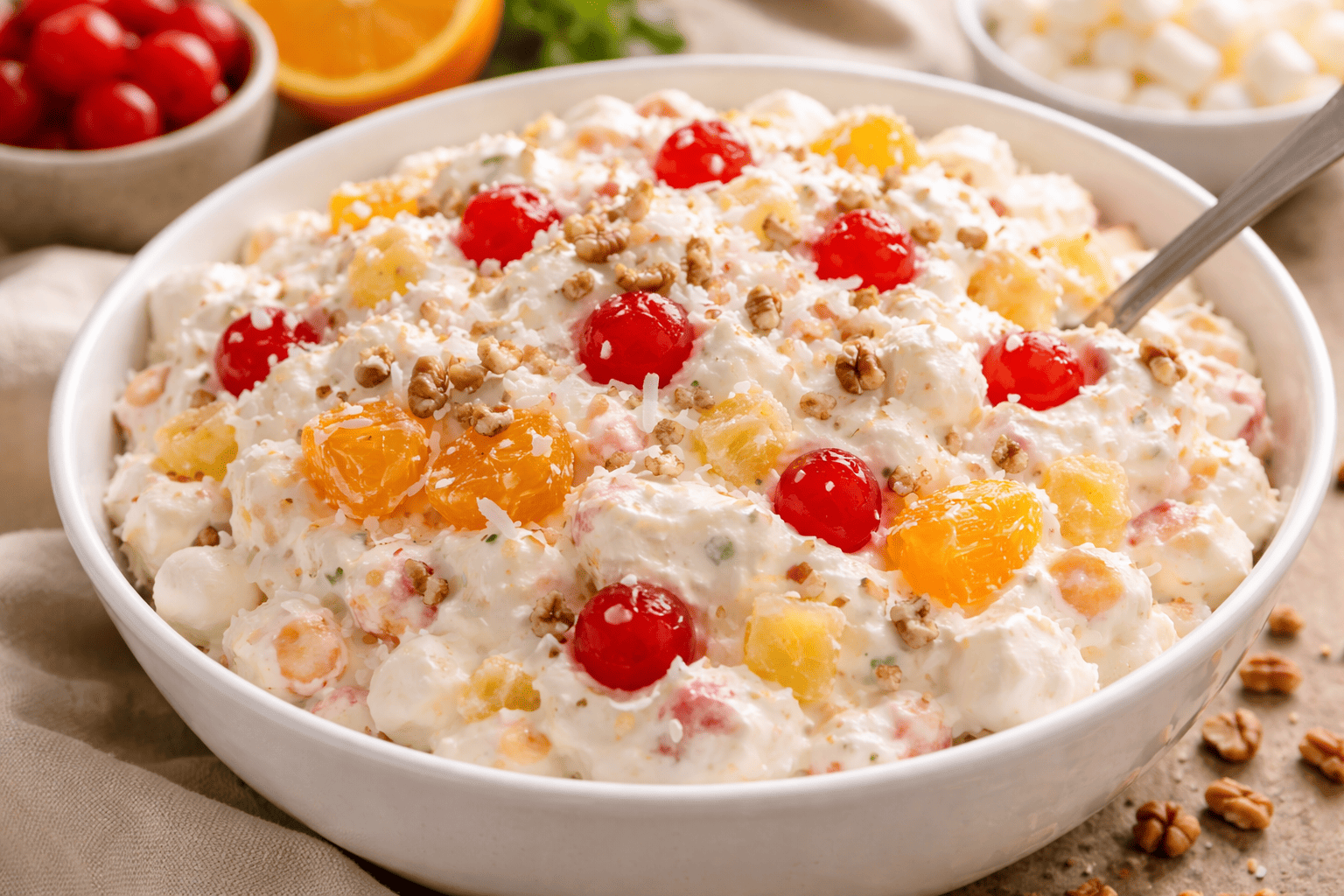
There is a particular category of dessert that belongs so completely to a specific time and place that encountering it feels almost like time travel. Sopapilla carries the warmth of a New Mexican kitchen, dusted with cinnamon sugar and served with honey, evoking something immediate and specific. Ambrosia dessert does something similar for a certain generation of American home cooks: one spoonful and you are back at a church potluck, a holiday table, or a summer reunion, surrounded by people who knew exactly what they were doing when they brought this to the gathering.
It is fashionable in some food circles to be condescending about ambrosia. That is a mistake.
What Is Ambrosia Dessert?
The name comes from Greek mythology, where ambrosia was the food of the gods — a fitting name for something that was, in its original nineteenth century form, considered an exotic and luxurious treat. Early ambrosia recipes were simple and elegant: fresh oranges and shredded coconut layered together in a glass dish, nothing more. The coconut was considered a novelty ingredient, and the combination was genuinely special by the standards of the era.
Over the following century, the recipe evolved substantially. Canned fruit entered the picture — mandarin oranges, crushed pineapple, maraschino cherries. Miniature marshmallows became a near-universal addition. Sour cream or whipped cream folded through the fruit mixture transformed it from a fruit salad into something richer and more dessert-like. The result is what most people mean today when they say ambrosia dessert salad: a creamy, sweet, fruit-studded mixture that is simultaneously a salad and a dessert and entirely comfortable being both.
The Classic Recipe
A good ambrosia dessert recipe begins with well-drained canned fruit — the excess liquid must be removed thoroughly, or the finished dish becomes watery and loose. Mandarin orange segments, pineapple tidbits, and halved maraschino cherries form the fruit base. Shredded sweetened coconut and miniature marshmallows are folded in, providing texture and sweetness. The binding element is sour cream or whipped cream, or a combination of both, stirred gently through the mixture until everything is just coated.
The dish benefits enormously from resting overnight in the refrigerator. The marshmallows soften slightly into the cream, the coconut absorbs moisture and becomes tender, and the flavors meld into something more cohesive and rounded than the freshly assembled version. Make it the day before and it will be noticeably better for the wait.
The British Variations: Custard and Rice Pudding
While American ambrosia is defined by its whipped cream and fruit salad character, the name has also attached itself to a beloved British brand whose products occupy a different corner of the comfort dessert world entirely. Ambrosia custard — that particular ready-made Devon custard produced under the Ambrosia name — has been a fixture of British pudding culture for decades, poured warm over crumbles, pies, and steamed sponges with the kind of institutional reliability that makes it genuinely comforting.
Ambrosia devon custard is made in Lifton, Devon, using local milk, and its particular flavor — sweet, vanilla-forward, slightly thicker than homemade pouring custard — is so familiar to British consumers that it functions almost as a flavor memory rather than simply an ingredient. Ambrosia rice pudding occupies similar territory: thick, creamy, gently sweet, and available in tins that have looked more or less the same for generations. These products share little with American ambrosia beyond the name, but both earn their place in the dessert conversation on their own terms.
Why Ambrosia Endures
The American version of ambrosia persists for reasons that have nothing to do with sophistication and everything to do with function. It requires no cooking, no special equipment, and no advanced technique. It can be made a day ahead. It travels well. It feeds a crowd. It makes people happy in an uncomplicated, immediate way that more elaborate desserts sometimes fail to achieve.
There is also genuine pleasure in the combination itself — the tang of sour cream against sweet fruit, the give of a softened marshmallow, the chew of coconut — that holds up to honest assessment. Ambrosia is not trying to impress anyone. It is trying to be delicious, and it succeeds.