
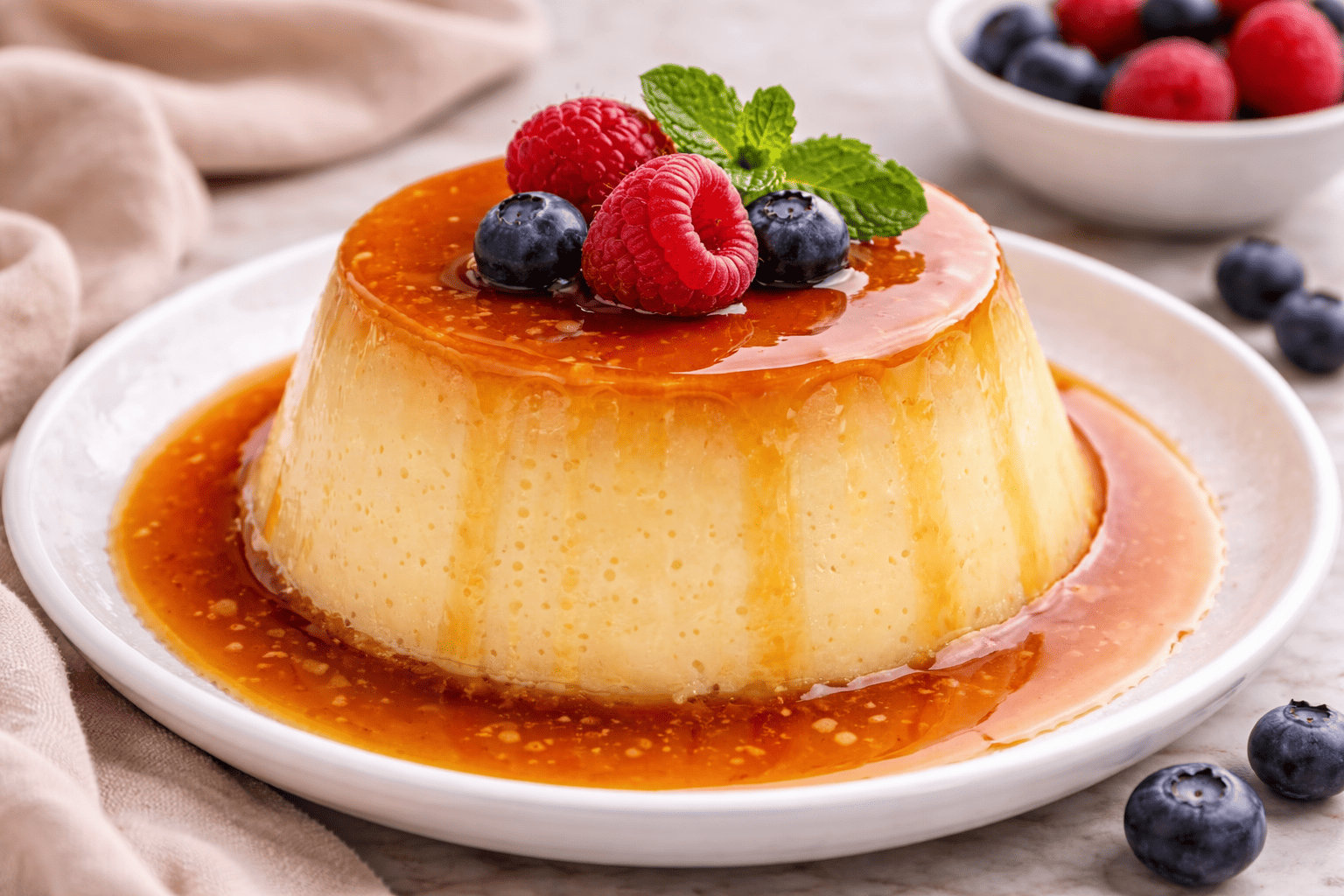
There is a category of dessert that relies not on layers or decoration or technical showmanship but on the sheer quality of a single texture done perfectly. Ambrosia dessert achieves its charm through the combination of soft fruit and cream folded together into something greater than its parts. Flan achieves something similar through an even simpler proposition: a perfectly set, trembling custard, turned out onto a plate with a pool of dark caramel running down its sides. It is one of the oldest and most widely loved desserts in the world, and it rewards the cook who takes it seriously.
What Is Flan?
Flan is a baked custard made from eggs, milk or cream, and sugar, cooked in a mold lined with caramel. When the custard is unmolded after baking and chilling, the caramel — which has liquefied during cooking — flows down over the surface of the custard in a dark, glossy stream, providing both sauce and visual drama in a single gesture. The custard itself is smooth, just barely set, and rich without being heavy.
The dish exists in one form or another across an enormous range of culinary traditions. Spain brought it to Latin America during the colonial period, where it took root and evolved into countless regional variations. France has its crème caramel, which is essentially the same dessert approached with Gallic precision. The Philippines developed leche flan, a particularly rich version made with egg yolks and condensed milk that is denser and sweeter than its European counterparts. Each tradition considers its version the correct one, and each tradition is right.
The Caramel: Non-Negotiable Care
The foundation of any good flan is the caramel, and making caramel sauce for creme caramel is a process that demands attention but rewards it generously. Sugar is melted in a dry pan over medium heat — either dry, without water, for a faster result with more direct control, or with a small amount of water added first for a more forgiving process. The sugar must be watched continuously and swirled rather than stirred as it melts and darkens.
The target is a deep amber color — darker than you might expect, almost the color of old mahogany — which produces a caramel with the complex, slightly bitter edge that balances the sweetness of the custard. Pull it too early and the caramel is flat and overly sweet; take it too far and it turns acrid. The window between perfect and burnt is narrow and moves quickly. Trust your eyes and your nose rather than a timer.
Making Flan: The Custard and the Bake
Making flan properly requires a water bath — the baking mold set inside a larger pan of hot water in the oven, which surrounds the custard with gentle, even heat and prevents the eggs from curdling or the surface from cracking. The ratio of eggs to liquid determines the final texture: more whole eggs produce a firmer set, more yolks alone produce a creamier, more luxurious result.
Chocolate flan, which incorporates melted dark chocolate or cocoa powder into the custard base, produces a richer, more intensely flavored variation that pairs particularly well with the bitterness of a well-made caramel. It bakes slightly longer than the plain version and benefits from an extra hour of chilling before unmolding.
Leche Flan and the Filipino Tradition
Leche flan — sometimes spelled lechflan in informal usage — occupies a special place in Filipino culinary culture, where it is a fixture of celebrations, family gatherings, and holiday tables. Made exclusively with egg yolks and sweetened condensed milk rather than whole eggs and fresh milk, it is significantly denser and richer than Spanish or French versions, with a deep yellow color and a sweetness that is unapologetic and deliberate. It is traditionally steamed rather than baked, which produces an exceptionally smooth surface and a uniformly silky texture throughout.
A Dessert of Universal Appeal
What makes flan endure across so many cultures and centuries is its fundamental honesty. There is nowhere to hide in a custard — the quality of the eggs, the care taken with the caramel, the patience of the water bath all show directly in the finished result. Make it well and it is one of the most satisfying desserts imaginable.